Applied Research
Applied Research in Climate Adaptation and Future Viability of Forest and Farm Systems
With a landscape that mirrors the make up of Vermont as a whole, Smokey House Center is an ideal setting to conduct research that helps Vermonters build a better future. We partner with regional scientists, researchers, non-profit partners, foresters, and farmers to develop trials across our landscape that inform better land stewardship practices. We are particularly focused on projects that help develop new land-based industries grounded in the ecology of place rather than the extraction of resources. We support our research partners in a variety of ways including access to our facilities and housing, collaborative grant writing, staff support for projects, and more.

Yale School of the Environment at Smokey House Center with local forester Steve Handfield
Research
Areas

Our forests are on the frontlines of the climate crisis as they endure intensified disturbance events like drought and flooding and a range of devastating new pests and pathogens. As forest-loving humans, we feel a deep obligation to help our forests continue to persist in the face of these threats by experimenting with adaptation strategies grounded in the principles of ecological forestry.
Climate Adaptive Forest Management

Vermont and the Northeast are experiencing the most significant housing shortage in decades at the same time that our region’s ability to process locally harvested wood into sustainable building materials has plummeted with the widespread closure of sawmills. Through experimental building projects and regional supply chain mapping, we are trialing building techniques that can jumpstart a new era of local wood use in modern green building.
Local Wood Utilization

Maple syrup is core to Vermont’s identity and economy, but less predictable sap flow seasons and increased climate-related impacts on sugar maple trees are posing new threats to syrup producers. All three of Smokey House Center’s sugarbushes house long-term experiments in collaboration with UVM’s Proctor Maple Research Center and Vermont Audubon focused on building both ecological and economic resilience into this forest-based industry.
Maple
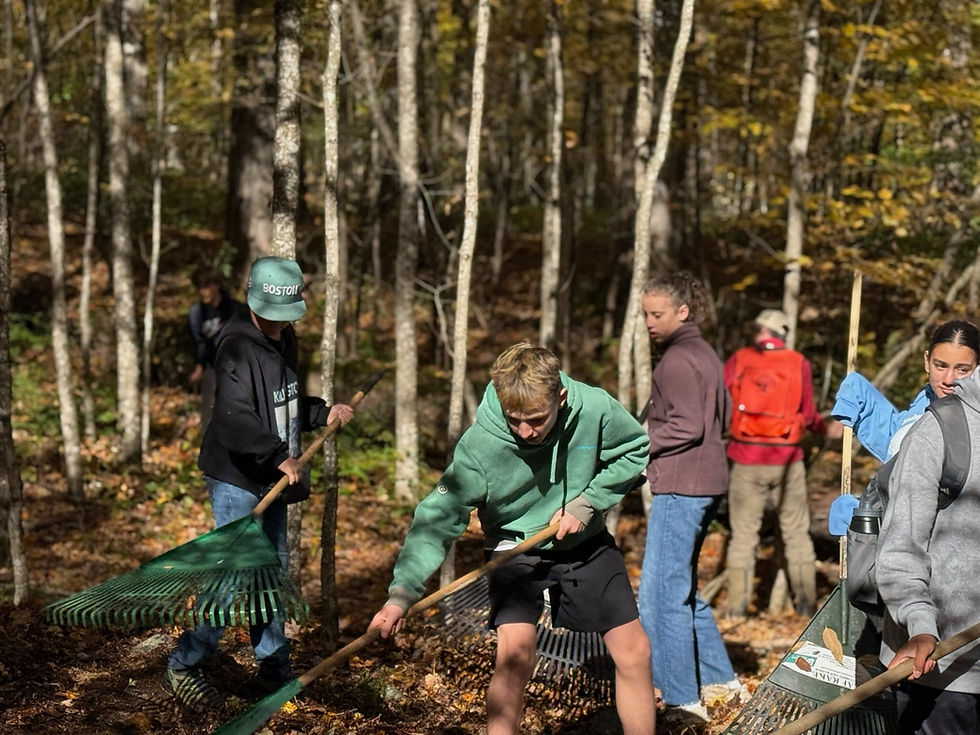
A transition to a more bioregional food system that centers perennial crops grown in ecologically-designed agroforestry systems can secure a more abundant and dignified future for our farmers, communities, and landscapes. Smokey House Center is trialing various agroforestry systems alongside its long-term partner farms including forest farming at-risk forest botanicals, creating sheep silvopasture, and growing a diversity of fruit and nut crops in a variety of systems.
Agroforestry

Nestled between the Green and Taconic Moutains as the partial headwaters of Otter Creek, Smokey House Center is defined by the sprawling 3,950 acres of forestland that make up the majority of the property. Heterogeneity in soils, topography, and past land use history has resulted in a remarkably diverse mix of forest types, natural communities, and wildlife habitat across the property. The resulting matrix of forested ecosystems–nearly all of which have been protected under a New England Forest Foundation conservation easement since 2002–have provided the foundation for the work that has been conducted at Smokey House for decades.
To learn more about the forest at Smokey House consider checking out the conservation management plan.
The Forest

Among Smokey House Center’s most valuable resources are the two commercial farms that hold long-term leases on its land: Yoder Farm and Dorset Peak Sheep and Cattle Company. As well as providing food for the surrounding communities and livelihoods for their farm families, these farms provide partnership by existing as living platforms for research. Smokey House Center also independently trials various agroforestry systems across fields that are not managed by their partner farms.
The Fields

Across this sprawling landscape stand over 40 buildings that make up the organization's facilities including old farm houses, barns, equipment sheds, sugarhouses, an office building, a woodshop, and a mechanics shop. These facilities not only sustain Smokey House Center's program by housing and supporting employees, farmers, and visting partners, but they also exist as a an experimental platform for integrating sustainably harvested wood materials—often harvested right from the surrounding forestlands—into both historic and modern building design.
The Facilities
Current Research Partners





Are you from a university, college, or nonprofit looking to bring research to Smokey House Center? Please fill out the form and Smokey House Center will followup with you.