
Walking the Land at Smokey House Center

Author Shaylen Roell
Published August 2026
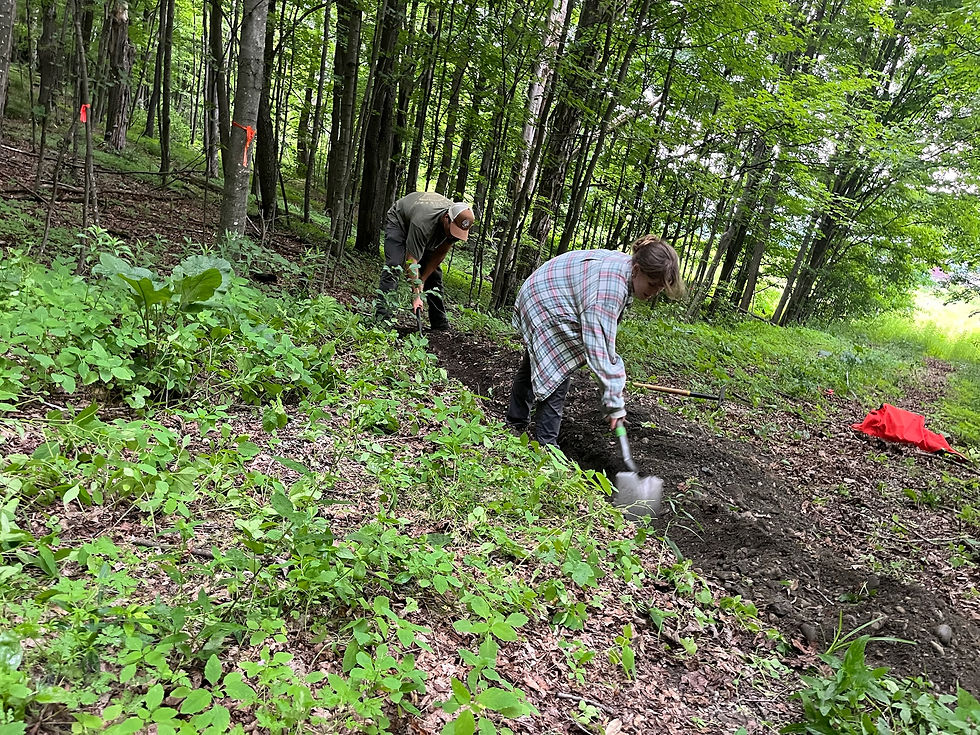
One of the best ways to get to know a piece of land is arguably to just go out and walk it. This is easier said than done, but in the case of Smokey House Center it was one of our main jobs this summer as apprentices to conduct a forest inventory of the property. This forest inventory comprised all of the Smokey House Center property that was forestland and below 2,500 ft in elevation. That is roughly 2,834 acres, and 236 inventory plots total. Although that originally sounded like a daunting task to complete in addition to all of the other projects on the agenda for the summer, it quickly turned into one of my favorite jobs.
With six interns total it was optimal to split up into groups of two, spending entire work days - starting at 6:30 if it was a particularly hot day - working through a predetermined set of plots, rain or shine. At each plot we would record seedlings and saplings in a fixed radius, overstory tree species and diameters in a variable radius, two tree heights, and a swath of habitat and site information. As the weeks went on we got more confident in our inventory skills and the time it took us to do each plot drastically decreased, although it varied greatly per site and weather.
The inventory plots themselves were fun, but it was primarily the travel between plots that allowed us to cover great portions of the property and truly appreciate the diversity of habitats. Although I didn't get to explore all of it, I’m extremely grateful for all that I did see. I mainly found myself drawn to conduct inventory at higher elevations when possible, but I did also get to explore some lower areas.
Although there is a persistent element of sugar maple throughout the Smokey House Center property, there is wonderful tree species diversity here as well. I couldn't help but marvel constantly at how the forest composition would shift from one plot to the next. Just from my memory I recalled 28 different native tree species that we saw while conducting forest inventory. I could sit here and name all the wonderful species but instead I’ll point out a few sites that stuck out in my mind.
Some of my favorites were the highest elevation plots up Dorset Peak. The slope was always steep, but the pain in my ankles from walking along 45 degree contour lines was worth it. There were a multitude of small streambeds, some carved deep ravines into the mountain, and some sat right below the surface creating slick muddy runways downslope. Crossing rocky streambeds on Dorset Peak always meant splashing some water on your face and dunking your hat in before putting it back on your head. There were magnificent yellow birch and lots of young spruce clinging to rocky outcroppings. Lush moss grew on rocks and trees alike and shelf mushrooms the size of dinner plates were stacked high on fresh snags. Although we traversed the land with our goal of completing inventory plots in mind, we always made sure to point out the beauty that we saw, and make short stops to take it all in.
Another memorable day included a traipse around some lower elevation land that took us to many different habitats. We started off jumping across little streams and fighting through thick brush and ferns. Then transitioned into a stand of large white pine that all seemed to be competing for tallest tree. The land opened up into a swampy area where many of these towering white pines had been blown down. They scattered the ground as if a giant had come through and thrown them every which way, leaving them there for us to climb over and duck under. We crossed the road, changing our scenery to an old orchard. It was now forest but several gnarled apple trees were still scattered about, as well as stone fences and wolfy sugar maples. Pushing in further we finally got to an eastern hemlock stand that cast a lovely shade over a small stream. I was enamored at the ever changing forest composition, and just how much there is to see if only you look.
During inventory, we not only witnessed the great diversity of habitats on the Smokey House Center property but also some creatures that inhabit them. This included sightings of a mama black bear and cubs, porcupines, white tailed deer, ruffed grouse, red backed salamanders, a woodland jumping mouse, red efts, wood frogs, American toads, garter snakes, scarlet tanagers, and signs of moose browse. I know that what we saw just scratched the surface of the critters at Smokey House Center since there is abundant habitat for nocturnal and crepuscular animals here too.
When we finally finished our forest inventory plots, there was a bittersweet feeling of accomplishment. Something that seemed so daunting at the beginning of the summer, was finally complete, and yet part of me wishes that we still had a few more plots to do. A few more chances to walk this land, gain a deeper understanding of the forest and its inhabitants, and pause on a walk between plots to take it all in. Alas, summer has slipped past us as it usually does, and my time at Smokey House Center has come to close for now. But I will always remember climbing the mountains and traversing the valleys in search of our next forest inventory plot. And when I pass through here next, I’ll be sure to slow down, take my time, and go for a walk in the woods.
______________________


Comments